Writing About Writing
April thirteenth, 2026. I find myself in a remote house half an hour's drive from Carcassonne, in the south of France. I'm here with a group of writers, all of whom take classes with the poet and writer Sylvie Marie. One of them owns this house. He and his wife were kind enough to invite us here so we could work on our writing projects in peace and learn from each other. A whole week with the focus entirely on writing! It's been a long time for me. Honestly, the idea fills me with anxiety. It's been a while since I've devoted myself seriously to anything. I haven't felt like writing for months; nor do I have any idea what to write. Now I sit here, trapped for a week in front of a laptop without internet while, through the window, I watch new shoots grow on the grapevines.
We began the first writing day with a round in which everyone shared their ambitions for the week. Some of us have a concrete project they want to continue working on, others are here to find inspiration. I fall somewhere between the two categories. I have several ongoing projects but at the same time none I really want to continue working on. Before breakfast, I took a short walk along a country lane. I hoped to encounter an inspiration there that could carry me through the week. As so often, all kinds of poems and stories drifted past my imagination like soap bubbles, bursting the moment I tried to catch them.
For example, I imagined a person who comes home from work and, against his better judgment, lights a joint so he can spend the rest of the evening in a numbing haze. But the moment I take the step toward a slightly more concrete elaboration — what work does this man do? what does his house look like? what is he trying to escape from? — I get stuck.
I notice that I lack the will or the capacity to develop a vague idea that appeals to me into a concrete story. For the past few years I've been a toddler playing with blocks. Sometimes something beautiful or inventive comes out of it. But you don't build a house that way.
So I came to the decision to start over. Or rather: to start over starting over. My writing is a constant beginning in which I try, each time, to leave behind everything that hasn't withstood the fire of my doubts. To suspend everything, then. To assume that I'm linguistically capable but otherwise know nothing at all about writing. A first question immediately presents itself: why write and not not write?
why not not write
If I can't manage to answer this question, I might as well pack my bags and leave the writing week early. Unfortunately, I don't have the answer ready, so my only option is to explore the question through writing until I reach a satisfying conclusion. Suppose I don't reach one — then my writing will turn out to be an endless attempt to justify itself. An idea I rather like, actually. But I'm getting ahead of myself.
That I'm on the right track with this question is proven by a passage from Rilke's Letters to a Young Poet. A small book by a great poet, which I brought along for inspiration and because it just barely fit in my suitcase.
No one can advise or help you — no one. There is only one way. Go into yourself. Find out the reason that commands you to write; see whether it has spread its roots into the very depths of your heart; confess to yourself whether you would have to die if you were forbidden to write. This most of all: ask yourself in the most silent hour of your night: must I write?
Must I write? I don't write for pleasure. I can think of many other activities that bring me more pleasure. And if there is a pleasure unique to writing, it's the pleasure of knowing that you're doing what you must do. In the same way, not writing is also a pleasure: the pleasure of precisely not doing what you must do. Both pleasures presuppose the same must. Without that must, writing is a hobby and not writing is a meaningless concept.
I have periods in which I don't write at all. They can last months, sometimes years. They always end with a feeling of suffocation. As if something inside me is building up until it has no choice but to explode and come out in a flood of words about which I always think, at the moment, yes this is it now, but afterwards have to admit that it still wasn't quite that. For look at me here yet again, asking myself what on earth I'm doing.
That urge is always present, whether I respond to it or not. The last time I recognized that urge I was in Lille. An exhibition about the work of the Russian painter Wassily Kandinsky, one of the founders of abstract art. His work is enormously expressive in its use of color and form. I can't explain it, but his work moves me deeply.
What he does with colors and forms, I want to be able to do with words. So for me, language is a medium, just as painting was for Kandinsky. I find that already an important observation. There is a drive toward expression that needs a medium in order to be expressed, but can never be reduced to that medium.
This is why I feel more kinship with the painter Kandinsky than with, just to name someone, the writer Dan Brown. It's not about the medium, but about the intention I read in their art. With Dan Brown I see a focus on the result: writing a well-constructed and gripping thriller. Kandinsky, on the other hand, kept painting the way he felt he had to paint, even though his work was repeatedly torn apart by the art community of his time. Above the noise of the critics rings the question: how do you experience the world?
The least I can say about myself is that I am a human being who lives among other human beings in a world over which I have little control. In so many years I will die. There's nothing special about that. Plants and animals die too. Only I know that I live, and I know that I will die, and I know that I am me. My consciousness forms a unity that is part of the world, but also sets itself against it. The PC I'm typing this on isn't me. The writing teacher who gives me inspiration, the fellow students who give me feedback aren't me either. The ground of what I am eludes them and is situated right at the boundary between myself and the outside world.
Now that I'm here, it's so clear that there can no longer be any doubt. The will to write is the consequence of the inner necessity to escape the inescapable loneliness of the individual in the world. The tension between the one and the all. Surprising how quickly I've reached a conclusion.
A conclusion full of contradictions. The escape is impossible from the start. No work will reconcile the individual with the world. The writer undertakes something he already knows will fail, and yet he can't help doing it. Moreover, writing is precisely a solitary activity. It is by withdrawing from the outside world that the writer can give shape to his inner world, so that it can spread itself like a transparent membrane over reality.
me, you, and the world
We're halfway through the writing week. We just ate a delicious potato salad for lunch. I've achieved a lot, and at the same time nothing. I now know why I write, but that doesn't bring me one step closer to a concrete story or poem. Yet a next question presents itself.
The writer in my previous pieces lived alone in the world. I don't believe such a thing is possible. The philosopher Wittgenstein worked out the argument that a private language — a language intelligible only to a single individual — is impossible. We can say the same about art. It's only when what's been written is read by others that it truly comes to life, and a text comes into being. By withdrawing from humanity, the poet creates something that connects them. But that connection is only real when someone else picks it up.
This morning I read the following in Rilke's Letters to a Young Poet.
And if out of this turning inward, out of this immersion in your own world, poems come, then it will not occur to you to ask anyone whether they are good poems. Nor will you try to interest magazines in this work, for you will see them as your dear natural possession, a piece and a voice of your own life.
I recognize something very important here. It is the writer himself who is the first reader of his work. And yet. How difficult is it not to let our sense of self-worth as writers depend on others? I don't want to count the times I've put away my pen after a reading that didn't land, a publication that was rejected, or a contest I didn't win.
Yet the experience of the other is also more than a judgment. It is oxygen. I experience that here in the feedback sessions and conversations in between. We read, for instance, a science fiction story by a fellow writer. It was a very well-written, gripping story. At a turning point, the main character leaves his hometown for a new life. His beloved follows him. Why does she decide to leave her entire life behind and follow him? We didn't read that in the text.
When we asked our fellow writer about this, he couldn't give us an answer either. What followed was an entire conversation about the importance of psychologically deepening characters, and more specifically the often passive role of female characters in fantasy or science fiction stories.
Why am I telling this? It's only because we read this story through different eyes, and thus brought it to life from our own frame of reference, that this gap surfaced in his story. I write gap because it really is a gap. Our fellow writer realized this immediately himself. It's then up to him to do something with it. To ask himself who that woman, whom he invented somewhat gratuitously, really is. Whether and how he changes his story is entirely up to him. But in a certain way, it's no longer his story alone. We have read it. We have seen it. We've confronted him with his own blindness.
I've used a fellow writer as an example here, but to be clear: this happens to me here too. Constantly. It's precisely in that interaction that I feel my text lives, and means something.
Every writer who pretends that the reception of his work leaves him indifferent is a hypocrite. Not because writers are vain, even though they often are. The reason is more essential. A writer's work needs readers in order to be a work. There can be few readers, the writer can even be his own reader, but without the other there is no art.
The pain of a writer who isn't recognized must therefore be split in two. On the one hand the bruised ego, the they don't see me, which we must free ourselves from. On the other hand the concern for the work itself, the realization that a work needs readers in order to come to life. If I understand the quote correctly, Rilke thinks you only need to look inside yourself. I don't agree. My own work has gotten better precisely because I took the step of joining a group. A group of people who dare to look each other's work straight in the eye.
the subject
I now know why I write. But how do I translate that into a concrete story or poem? A story needs a subject, and so does a poem. Does it just blow in spontaneously, do you go searching for it in the world, or is the choice the result of a deliberate process? It's all three at once, of course. A choice that's purely the result of a rational project lacks vitality. Spontaneity is necessary, but not sufficient, because why do we give ear to one idea and not another?
If writing situates itself on the border between the individual and the world, then it is the writer's task to know both himself and the world. All writing is personal, which doesn't mean the subject has to be the writer himself. I can write about my own fears as if they had nothing to do with me, while I could write about a pregnant woman as if I were about to bring a child into the world myself. What counts is a personal involvement with the world, not the direct link between writer and subject.
I could, for example, start from my fear of needles. Out of that could come a thriller about a serial killer who mutilates his victims with needles. If it's aimed at entertaining the public, in my view it's worthless. But if it leads to an investigation of what exactly makes those needles so frightening, then we get a very different story. The needle pierces our skin, and with it the illusion that there exists an I that can live on its own, untouched by the brutal capriciousness of the world. It's not the subject itself that's decisive, but the question: what does this say about my relationship to the world? If something resonates there, it's a good subject. I write resonates, because the answer doesn't have to be given in advance. As a writer you can only gamble that you've grasped the right subject. You still have to make it into the right answer afterwards. The work is the answer.
I'm reminded of these lines by the Palestinian poet Marwan Makhoul.
In order for me to write poetry that isn't political
I must listen to the birds
and in order to hear the birds
the warplanes must be silent.
Here the subject isn't chosen. It's imposed by a reality so loud that it drowns out every other voice. But what strikes me most is not what Makhoul says, it's how he says it. He doesn't write: war makes all poetry political. He lets you hear it. The birds that should be there. The planes that shouldn't be there. The technique cannot be separated from the subject.
technique
But what is technique? Technique, I can already hear the teacher say, is mastery of the medium. If you want to become a musician you have to choose an instrument and learn to play it. You have to learn to read notes and acquire the skill to play the right notes at the right moments. The same goes for writing. You have to master the language, you can learn different ways to build a poem, follow a rhyme scheme, structure a story, set up a character. This, I would say, is the objective part of technique, a baseline of what you must minimally be able to do in order to make art. How high that bar lies depends on the kind of art you want to make. A simple pop song can be much more powerful than a difficult classical piece.
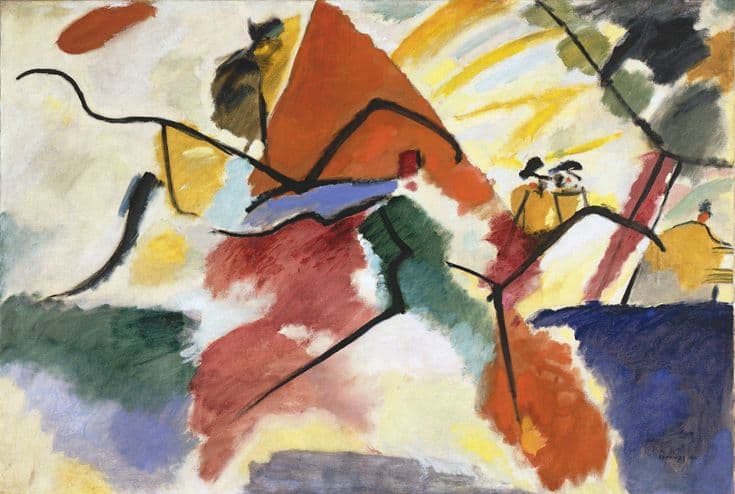
What makes one technically accomplished work move us, and another not? I turn back to Kandinsky to answer this question. Kandinsky moves me. At the exhibition in Lille I saw the work Impression V.
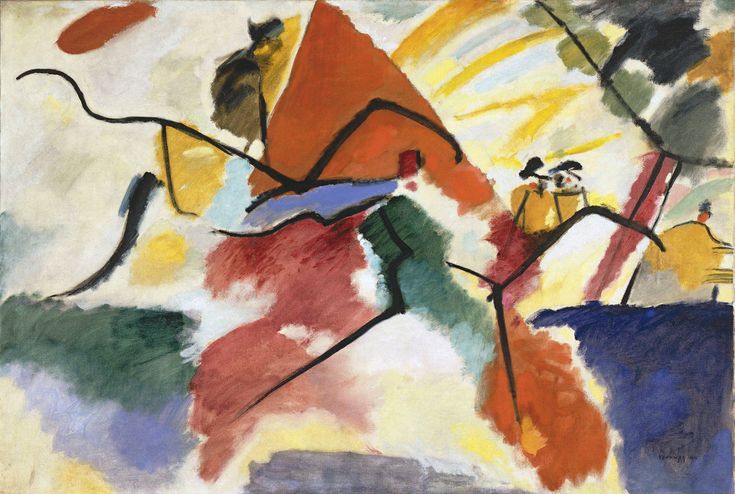
Look at it with me for a moment. Do you see how the black lines still just barely look like horses? Top left, a tail curls. To the left of the red triangle in the middle, a black smudge. It could be a rider. And the triangle itself, is that a mountain?
Above all, it's the play of forms and colors that fascinates. It's almost mystical how, on the one hand, they seem sloppily colored next to each other, and on the other hand, they complement each other perfectly. The few concrete depictions have a rich symbolic value — the rider, for Kandinsky, stands for freedom and movement. Things are captured in their essence. It's the colors themselves that evoke a feeling, not what they depict. Kandinsky had a whole theory about this: red radiates strength and liveliness, blue is the color of spirituality, yellow is aggressive and earthy, green is passivity, white is potential and black is death.
Whether his color theory is right or not, it forms a thought-out whole with which Kandinsky could go to work to arrive at compositions that could immediately move someone like me, who knew nothing of all that. This is what we might call subjective technique. Kandinsky's colors repeat themselves throughout his works, giving them a thematic charge that transcends the individual works. A writer might choose short, sharp sentences from which all superfluous words have been banished, or might be known for rich, ornate language. Every choice an artist makes can be traced back to his relationship with the world.
This part of technique is much harder, both for the artist and for the one who beholds the artwork. As an artist you can do nothing other than spend a lot of time with your material, experimenting, feeling, reflecting, until your personality takes shape down to the smallest details throughout the works you make.
And as a viewer you are much more than just a viewer. You are the last link needed to bring the work to life. Perhaps a work is truly strong precisely when it shows us something of our experience that we as viewers didn't yet know, and yet recognize. The Kandinsky painting above is not just a happy find, or a feat of painterly mastery. It's a phase in a lifelong search for the meaning of art and life. That I recognize it without knowing his theory, that it moves me without my being able to explain why — that is the proof that subjective technique works. The experience that Kandinsky has placed in it finds a point of contact in mine. From that point of contact, my own experience is enriched, and my bond with humanity made more intimate.
And so, not only within the works themselves, but also between the works, a unity arises. Alongside repetition there is difference. A progression. A search that transcends the individual work. If that succeeds well enough, as with someone like Kandinsky, then it's like a flower in full bloom. His entire being comes together in an expression that leaves us as viewers speechless, because we see ourselves expressed in it, in a way we hadn't known before. The flower doesn't bloom in order to be beautiful. The flower blooms because its nature compels it. Just as the writer must write.
the prelude to a beginning
We've now reached the end of the writing week. What a week it's been. Texts that had long been sitting in the waiting room have been thoroughly polished, read and discussed. For some it was a new start. A few of us have searched more than we've found.
I myself wrote on this essay productively. I'm glad about that. At the same time I ask myself: have I really done anything? Wasn't this essay also a way of not really writing? What am I doing with this writing about writing?
I've sat down alone in a room for this ending. A fat housefly buzzes stubbornly around. I could open a window, but I don't. As if the fly is my doubt and I just sit with it. I still don't know how to concretely begin now. Was the idea of the man with the joint worth elaborating? Should I think more deeply about Kandinsky's works in order to distill poems from them?
Somewhere I had hoped that with the writing of this text I would arrive at a fixed method to develop my writing further. A handhold for choosing subjects, learning techniques, deepening my own voice. I notice that it doesn't work that way. It would also be all too easy if there were a fixed method for making art. There is no alternative to the laborious process of self-realization through interaction with language.
What I do know now is something about myself. I don't belong to the writers who spontaneously build their oeuvre. I've always felt the urge to question incessantly everything I do. For a long time I suppressed that urge because I felt I first had to write and earn my stripes before I was allowed to say anything about writing, but each time I arrive at the same observation. I can't write without knowing why I write. To find that out, I have to write about writing. And so this text is not yet the new start I had hoped for, but perhaps the prelude that can lead to that start.
Glad to have arrived at this conclusion, and exhausted by the effort, I decide to take a walk. I step between fields full of old grapevine stocks from which new shoots are growing.